Discworld Books in Order
#
Title
Date
About the Discworld series
Series Premise
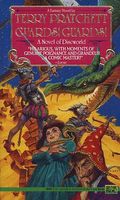
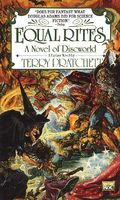
The Discworld is a flat, disc-shaped world carried on the backs of four giant elephants who stand on the shell of a gigantic space-faring turtle named Great A'Tuin. This absurd cosmological setup immediately signals that the series is not traditional high fantasy. Instead, Discworld is a satirical mirror of our own world, using a magical, medieval-to-early-industrial fantasy setting to lampoon real-world institutions, philosophies, politics, religions, and human behavior. The novels are mostly standalone (or loosely grouped into sub-series), each focusing on a different aspect of Discworld society: - The City Watch sub-series (crime and policing in Ankh-Morpork) - The Witches sub-series (Lancre witches dealing with folklore and human nature) - The Death sub-series (Death and his family grappling with mortality) - The Wizards sub-series (Unseen University faculty causing chaos) - The Tiffany Aching sub-series (young witch coming-of-age tales) - Standalone novels and other arcs (Moist von Lipwig’s industrial revolutions, Rincewind’s misadventures, etc.) The overarching premise is that Discworld is a place where magic exists but is treated as a force of nature (and often unreliable), gods are real but petty and bureaucratic, heroes are rare and usually incompetent, and ordinary people (and non-humans) muddle through life with cynicism, ingenuity, and surprising decency. Pratchett uses fantasy tropes to satirize everything from organized religion and bureaucracy to journalism, war, racism, sexism, capitalism, and environmental destruction—always with compassion and a belief in the redemptive power of humanity.
Main Characters
The series features a large ensemble cast, with rotating protagonists across sub-series:
- Sam Vimes — Commander of the Ankh-Morpork City Watch (Night Watch sub-series). Cynical, alcoholic (later recovering), brilliant detective. Starts as a drunken wreck and becomes one of the most principled men in the city. Married to Lady Sybil Ramkin.
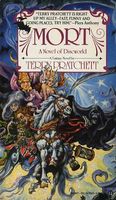
- Death — The anthropomorphic personification of Death (Death sub-series). Skeletal, speaks in ALL CAPS, deeply fascinated by humanity. Has an adopted daughter (Ysabell), a granddaughter (Susan), and a manservant (Albert).
- Granny Weatherwax (Esmerelda Weatherwax) — Most powerful witch in the Disc (Witches sub-series). Stern, morally uncompromising, fiercely intelligent, and deeply kind beneath her gruff exterior.
- Nanny Ogg (Gytha Ogg) — Granny’s best friend. Jolly, earthy, mother of many children, expert in folk magic and gossip.
- Tiffany Aching — Young witch (young adult sub-series). Practical, brave, and fiercely protective of her land and people.
- Rincewind — The incompetent wizard (Rincewind sub-series). Cowardly, fast-running, and constantly in the wrong place at the wrong time. Survives through luck and cowardice.
- Moist von Lipwig — Con man turned reformer (Moist von Lipwig sub-series). Charismatic, fast-talking, and morally flexible; revitalizes Ankh-Morpork’s institutions.
- Other key figures — Lord Vetinari (Patrician of Ankh-Morpork), Carrot Ironfoundersson (naive but brilliant Watch captain), Nobby Nobbs (disgustingly human corporal), Fred Colon (long-suffering sergeant), Susan Sto Helit (Death’s granddaughter), and the Librarian (an orangutan).
Setting
The Discworld is a flat, disc-shaped planet carried through space on the backs of four giant elephants standing on the shell of the enormous turtle Great A'Tuin. The disc is roughly 10,000 miles in diameter, with a central hub of mountains (the Hublands) and a rim where the ocean falls off into the void. Magic is real but decaying (the disc’s magic is slowly fading), and the laws of physics are more suggestions than rules—narrative causality, morphic resonance, and the power of belief often override normal logic.
The most important location is Ankh-Morpork, the largest city on the Disc and a parody of London, New York, and every great metropolis. It is filthy, crowded, corrupt, and gloriously alive—a melting pot of humans, dwarfs, trolls, vampires, werewolves, zombies, golems, and more. The city is ruled (loosely) by the Patrician, Lord Vetinari, a brilliant, amoral, and ruthlessly competent tyrant who keeps order through cunning rather than force. Other recurring locations include:
- Lancre — a tiny, backward mountain kingdom ruled by King Verence and Queen Magrat (home of the witches)
- Überwald — a gothic, Eastern European-inspired region of werewolves, vampires, and dwarfs
- Genua — a fairy-tale kingdom gone wrong
- Klatch — a desert region inspired by the Middle East and North Africa
- The Agatean Empire — an isolationist empire inspired by imperial China
The world evolves over the series—from a purely medieval fantasy parody to a quasi-industrial society with newspapers, railways, postage stamps, and early technology.
Tone & Themes
Satirical, humane, witty, and deeply funny—comic fantasy with razor-sharp intelligence and a warm, forgiving heart. Pratchett’s tone is playful yet profoundly serious: he mocks folly, hypocrisy, and cruelty mercilessly, but never with malice. Humor ranges from puns and wordplay to absurd situations, biting social commentary, and laugh-out-loud set pieces, often delivered in footnotes or deadpan narration. Beneath the comedy is genuine empathy—characters are flawed, often ridiculous, but rarely evil for evil’s sake; even villains are given understandable motives. The series is optimistic and humanist: evil can be defeated (or at least contained) by cleverness, kindness, and stubborn decency rather than raw power. It is accessible yet intellectually rich—suitable for teenagers and adults alike, with layers of meaning that reveal themselves on rereading.
The Discworld series is a towering achievement in comic fantasy—41 novels (plus extras) of razor-sharp satire, profound humanity, and endless invention. Terry Pratchett created a world that is both absurdly funny and deeply wise, using a flat world on a turtle to hold up a mirror to our own. Through unforgettable characters—Sam Vimes’s stubborn decency, Granny Weatherwax’s iron morality, Death’s quiet curiosity, Moist von Lipwig’s cunning charm—Pratchett explored power, belief, justice, prejudice, progress, and the stubborn goodness that survives in ordinary people. The series is endlessly re-readable: hilarious on the surface, philosophical underneath, and profoundly humane at its core. It remains one of the greatest achievements in modern fantasy—a joyful, biting, compassionate celebration of humanity’s flaws and virtues. A masterpiece that makes you laugh, think, and believe in the power of stories to make the world better.
FAQ
How many books are in the Discworld series?
44 books total: 41 main + 3 extra stories
When will the next book in the series be released?
No new book is currently scheduled. The latest book, The Shepherd's Crown, was published in September 2015.
When was the most recent book released?
The Shepherd's Crown was published in September 2015.
What was the first book in the series?
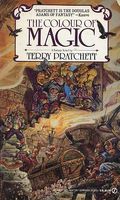
The first book in the series is The Colour of Magic, published in August 1983.
What genre is the Discworld series?
The series primarily falls into the Fantasy genre.
What is the Discworld series about?
The Discworld is a flat, disc-shaped world carried on the backs of four giant elephants who stand on the shell of a gigantic space-faring turtle named Great A'Tuin. This absurd cosmological setup immediately signals that the series is not traditional high fantasy. Instead, Discworld is a satirical mirror of our own world, using a magical, medieval-to-early-industrial fantasy setting to lampoon real-world institutions, philosophies, politics, religions, and human behavior. The novels are mostly standalone (or loosely grouped into sub-series), each focusing on a different aspect of Discworld society: - The City Watch sub-series (crime and policing in Ankh-Morpork) - The Witches sub-series (Lancre witches dealing with folklore and human nature) - The Death sub-series (Death and his family grappling with mortality) - The Wizards sub-series (Unseen University faculty causing chaos) - The Tiffany Aching sub-series (young witch coming-of-age tales) - Standalone novels and other arcs (Moist von Lipwig’s industrial revolutions, Rincewind’s misadventures, etc.) The overarching premise is that Discworld is a place where magic exists but is treated as a force of nature (and often unreliable), gods are real but petty and bureaucratic, heroes are rare and usually incompetent, and ordinary people (and non-humans) muddle through life with cynicism, ingenuity, and surprising decency. Pratchett uses fantasy tropes to satirize everything from organized religion and bureaucracy to journalism, war, racism, sexism, capitalism, and environmental destruction—always with compassion and a belief in the redemptive power of humanity.
Is the Discworld series finished?
The series does not currently have a new book scheduled.
More Series Like Discworld
If you enjoyed Discworld, here are more fantasy series to explore.