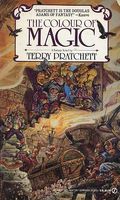
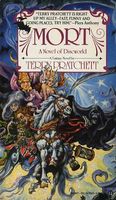
Discworld - Death Books in Order
#
Title
Date
About the Discworld - Death series
Series Premise
Death is an anthropomorphic personification—an immortal, seven-foot-tall skeleton in a black robe who speaks in small capitals and rides a white horse named Binky. He is not evil; he is simply the natural end of life, the one who escorts souls from the Discworld to the next world (whatever that may be). He does not judge, he merely arrives when the time comes. The Death books each give him a new problem that forces him to step outside his eternal role and interact with the living in ways he was never meant to: - In Mort, Death takes on an apprentice (Mort) to give himself a holiday, with predictably catastrophic but ultimately redemptive consequences. - In Reaper Man, Death is forcibly retired by the Auditors (cosmic bureaucrats who dislike personality), and the resulting chaos forces him to rediscover what it means to be alive. - In Soul Music, Death’s granddaughter Susan takes center stage as rock music (a new form of “magic†on the Disc) briefly replaces him. - In Hogfather, Death impersonates the Discworld’s version of Santa Claus (the Hogfather) when the real one is assassinated, leading to a hilarious and surprisingly moving meditation on belief. - In Thief of Time, Death confronts the Auditors again as they attempt to freeze time itself, forcing him to team up with humanity’s last hope—a very unusual clockmaker. The books are not about defeating evil in the conventional sense. They are about what happens when the personification of an inevitable natural process is forced to behave like a person—with curiosity, compassion, confusion, and even love. Death’s journey is one of gradually acquiring humanity while never ceasing to be Death.
Main Characters
Death — The central figure. A seven-foot skeleton in a black robe who speaks in SMALL CAPS. He has no pupils, but his eye sockets somehow convey expression. He rides Binky (a white horse), owns a scythe, and keeps a lifetimer for every living thing. He is not cruel; he is simply inevitable. Over the books he develops curiosity, compassion, and even a kind of love for humanity.
- Mort — Death’s first human apprentice in Mort. A gangly, kind-hearted teenager who temporarily takes over Death’s duties and falls in love with a princess.
- Susan Sto Helit — Death’s granddaughter (daughter of Mort and Ysabell). She becomes the de facto protagonist of several later books (Soul Music, Hogfather, Thief of Time). She is fierce, pragmatic, and terrifyingly competent—able to inherit Death’s powers when he is absent. She is the one who says “I’m not a person. I’m Death.â€
- Albert — Death’s manservant and former human wizard (Alberto Malich). Grumpy, cynical, and utterly devoted to Death. He cooks, cleans, and keeps Death grounded in domestic reality.
- Binky — Death’s horse. A perfectly ordinary white horse who has been trained to ride through the sky and ignore gravity.
- The Auditors — Recurring antagonists—gray-robed cosmic bureaucrats who hate life, individuality, and anything that cannot be measured. They are the closest thing the series has to pure evil.
Setting
The Discworld is a flat world carried through space on the backs of four giant elephants standing on the shell of Great A’Tuın, the star turtle. The Death books are mostly set in the sto Plains and the city of Ankh-Morpork—the largest, dirtiest, most corrupt, and most alive city on the Disc—but they also visit:
- Death’s own domain—a timeless, black-and-white landscape with a garden of black roses, a cottage with a bathroom that has running hot and cold water (because Death thinks it should), and a scythe that is both literal and metaphorical.
- Ankh-Morpork’s streets, taverns, and rooftops.
- The university city of Quirm and other small towns.
- The Unseen University (occasionally).
- The Ankh-Morpork Opera House (Maskerade).
- The Tooth Fairy’s realm and the Auditors’ realm (abstract, bureaucratic voids).
The Discworld is a place where magic is real, belief shapes reality, and stories have power. Death’s realm is stark and minimalist—black and white, silent except for the ticking of the lifetimers (hourglasses that measure each person’s remaining life). The contrast between the noisy, colorful, chaotic Disc and Death’s quiet domain is one of the series’ most effective visual and thematic motifs.
Tone & Themes
The tone is witty, humane, ironic, and profoundly compassionate—Pratchett at his most philosophical and emotionally generous. The prose is elegant, playful, and packed with footnotes, puns, and sideways observations about life and death. Death himself speaks in small capitals and has a dry, literal-minded sense of humor that is both terrifying and oddly endearing (“I USUALLY TAKE THE TIME TO GET TO KNOW MY CLIENTS. IT’S ONLY POLITE.â€). The books balance laugh-out-loud comedy with genuine poignancy. Death’s encounters with the living are frequently absurd (he tries to understand cats, or takes a job as a short-order cook), but they are also deeply moving—he genuinely cares about the people he meets, even though he cannot save them from dying. The humor never mocks death itself; it mocks the human refusal to accept it, and the ridiculous ways we try to avoid it. Beneath the jokes lies a quiet, unsentimental affirmation of life: it is short, messy, and beautiful, and every moment matters.
Terry Pratchett’s Death books—(with Susan carrying the torch in later Discworld novels)—are among the most profound, funny, and humane works in modern fantasy. Through the eyes of Death himself—a literal skeleton who learns to love life—they explore mortality, duty, belief, music, time, and the small acts of kindness that make existence meaningful. The books are laugh-out-loud hilarious, deeply philosophical, and unexpectedly moving. Death is not a grim reaper; he is polite, curious, and compassionate. He does not cause death—he merely arrives when it is time, and he does so with dignity and, increasingly, with affection for the fragile creatures he escorts. In a universe that runs on narrative and absurdity, these books remind us that even Death can have a heart, and that the most important things in life are the moments we share before the lifetimer runs out. Few fictional characters are as wise, as funny, or as quietly loving as Pratchett’s Death. The books are a gift—read them, laugh, cry a little, and remember to live while you can.
FAQ
How many books are in the Discworld - Death series?
5 books
When will the next book in the series be released?
No new book is currently scheduled. The latest book, Thief of Time, was published in May 2001.
When was the most recent book released?
Thief of Time was published in May 2001.
What was the first book in the series?
The first book in the series is Mort, published in November 1987.
What genre is the Discworld - Death series?
The series primarily falls into the Fantasy genre.
What is the Discworld - Death series about?
Death is an anthropomorphic personification—an immortal, seven-foot-tall skeleton in a black robe who speaks in small capitals and rides a white horse named Binky. He is not evil; he is simply the natural end of life, the one who escorts souls from the Discworld to the next world (whatever that may be). He does not judge, he merely arrives when the time comes. The Death books each give him a new problem that forces him to step outside his eternal role and interact with the living in ways he was never meant to: - In Mort, Death takes on an apprentice (Mort) to give himself a holiday, with predictably catastrophic but ultimately redemptive consequences. - In Reaper Man, Death is forcibly retired by the Auditors (cosmic bureaucrats who dislike personality), and the resulting chaos forces him to rediscover what it means to be alive. - In Soul Music, Death’s granddaughter Susan takes center stage as rock music (a new form of “magic†on the Disc) briefly replaces him. - In Hogfather, Death impersonates the Discworld’s version of Santa Claus (the Hogfather) when the real one is assassinated, leading to a hilarious and surprisingly moving meditation on belief. - In Thief of Time, Death confronts the Auditors again as they attempt to freeze time itself, forcing him to team up with humanity’s last hope—a very unusual clockmaker. The books are not about defeating evil in the conventional sense. They are about what happens when the personification of an inevitable natural process is forced to behave like a person—with curiosity, compassion, confusion, and even love. Death’s journey is one of gradually acquiring humanity while never ceasing to be Death.
Is the Discworld - Death series finished?
The series does not currently have a new book scheduled.
More Series Like Discworld - Death
If you enjoyed Discworld - Death, here are more fantasy series to explore.