Discworld - Rincewind Books in Order
#
Title
Date
About the Discworld - Rincewind series
Series Premise
Rincewind, the Discworld's most inept and cowardly "wizard" (he can't actually perform magic effectively and famously can't even spell "wizard"), is repeatedly thrust into absurd, world-threatening adventures despite his desperate desire to avoid danger, heroism, or anything resembling effort. Stories often parody classic fantasy tropes (e.g., sword-and-sorcery quests, barbarian heroes, travelogues, Faustian bargains, imperial politics, and exploration tales), with Rincewind as the reluctant, sarcastic everyman who survives through sheer luck, fast running, quick wits, and narrative causality. Plots involve chaotic journeys across the flat, magic-saturated Discworld (carried on the backs of four giant elephants atop Great A'Tuin the world-turtle), escalating disasters turned into minor problems (or vice versa), and satirical takes on real-world cultures/history/mythology. Recurring elements include his sentient, man-eating, multi-legged Luggage companion and brushes with cosmic threats, gods, or bureaucracy.
Main Characters
Rincewind — The central, titular anti-hero; a failed wizard with one powerful spell lodged in his head (which he fears unleashing), a talent for languages, survival instinct, and epic cowardice. He's polite, sarcastic, street-smart, and perpetually unlucky—yet somehow always ends up saving the day (accidentally). His philosophy: running away is the best strategy, and heroism is for other people.
> The Luggage — Rincewind's indestructible, sapient, ambulatory chest (made of sapient pearwood); fiercely loyal, teleporting, man-eating, and terrifying—acts as both protector and comic relief, following Rincewind obsessively.
> Twoflower — The naive, enthusiastic tourist from the Counterweight Continent (in the first two books); wide-eyed explorer with a camera-like "iconograph," insurance obsession, and cheerful obliviousness to danger; introduces Rincewind to adventuring.
> Recurring supporting figures (varying by book): The Archchancellor and Unseen University faculty (e.g., Ridcully in later appearances), barbarian heroes like Cohen the Barbarian, demons, gods, and various exasperated authority figures who drag Rincewind into quests.
Key books in the Rincewind-focused arc (chronological/publication order, core starring roles):
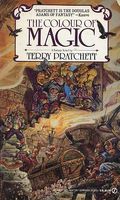
The Colour of Magic (1983) — Introduces Rincewind and Twoflower; parody of fantasy travelogues.
The Light Fantastic (1986) — Direct sequel; world-ending threat.
Sourcery (1988) — Sourcerer apocalypse.
Eric (1990) — Illustrated novella; Faust parody.
Interesting Times (1994) — Revolution in the Agatean Empire.
The Last Continent (1998) — Parody of Australia/exploration.
The Last Hero (2001) — Graphic novella with Cohen; heroic quest.
Setting
The Discworld—a flat, disc-shaped fantasy planet carried through space on the backs of four enormous elephants standing on the shell of the star turtle Great A'Tuin. Primary locations include:
> Ankh-Morpork — the sprawling, corrupt, medieval-fantasy metropolis (hub of many stories).
> Unseen University — the ancient, dysfunctional school for wizards where Rincewind is nominally a faculty member (later as Egregious > Professor of Cruel and Unusual Geography).
> Exotic/fantastical locales across the Disc — from barbarian wastelands and dragon-haunted mountains to the Counterweight Continent (pseudo-Asian empire), faux-Australia (XXXX), and mythical islands.
Tone & Themes
Hilarious, irreverent, and sharply satirical—classic Pratchett humor full of puns, wordplay, absurd situations, biting social commentary, and affectionate mockery of fantasy clichés. It's witty, fast-paced, and light-hearted with a cynical edge, blending slapstick comedy, clever observations on human nature, and occasional poignant moments beneath the chaos. Early books are more parody-heavy and episodic; later ones mature slightly while retaining the core "running away" gag and anti-heroic charm.
Rincewind appears briefly in other Discworld books (e.g., Mort, some Wizards tales), but this arc forms his dedicated storyline. The subseries is ideal for fans of humorous fantasy like The Hitchhiker's Guide to the Galaxy or Good Omens, offering accessible entry into Discworld's wit while poking fun at the genre itself.
FAQ
How many books are in the Discworld - Rincewind series?
7 books
When will the next book in the series be released?
No new book is currently scheduled. The latest book, The Last Hero, was published in October 2001.
When was the most recent book released?
The Last Hero was published in October 2001.
What was the first book in the series?
The first book in the series is The Colour of Magic, published in August 1983.
What genre is the Discworld - Rincewind series?
The series primarily falls into the Fantasy genre.
What is the Discworld - Rincewind series about?
Rincewind, the Discworld's most inept and cowardly "wizard" (he can't actually perform magic effectively and famously can't even spell "wizard"), is repeatedly thrust into absurd, world-threatening adventures despite his desperate desire to avoid danger, heroism, or anything resembling effort. Stories often parody classic fantasy tropes (e.g., sword-and-sorcery quests, barbarian heroes, travelogues, Faustian bargains, imperial politics, and exploration tales), with Rincewind as the reluctant, sarcastic everyman who survives through sheer luck, fast running, quick wits, and narrative causality. Plots involve chaotic journeys across the flat, magic-saturated Discworld (carried on the backs of four giant elephants atop Great A'Tuin the world-turtle), escalating disasters turned into minor problems (or vice versa), and satirical takes on real-world cultures/history/mythology. Recurring elements include his sentient, man-eating, multi-legged Luggage companion and brushes with cosmic threats, gods, or bureaucracy.
Is the Discworld - Rincewind series finished?
The series does not currently have a new book scheduled.
More Series Like Discworld - Rincewind
If you enjoyed Discworld - Rincewind, here are more fantasy series to explore.