
Transmetropolitan Books in Order
How to Read the Transmetropolitan series
Read in order—each book builds directly on the previous one.
The series is best experienced in sequential reading order. While early installments function as self-contained, vignette-style explorations of The City's weird wonders and Spider's reintegration, the narrative gains momentum and depth as overarching plots involving political intrigue, conspiracies, and character arcs unfold. Later volumes build directly on prior events, relationships, and revelations, creating a cohesive escalation from personal journalistic battles to city-wide and national crises. Although the gonzo style allows for some episodic enjoyment, following the chronology rewards readers with richer context on Spider's evolution, the shifting power dynamics, and the accumulating consequences of his actions. Standalone specials exist but enhance rather than replace the main flow.
About the Transmetropolitan series
Series Premise
The core premise revolves around Spider Jerusalem, a legendary and reclusive gonzo journalist who emerges from self-imposed exile in a mountain retreat to plunge back into the heart of a sprawling, hyper-advanced metropolis known simply as The City. Hounded by deadlines and his own demons, Spider resumes his role as a relentless investigative reporter for the newspaper The Word, wielding his pen—and an arsenal of futuristic gadgets and drugs—as weapons against corruption, hypocrisy, and institutional rot. His stories expose the underbelly of a society where technology has accelerated every vice and virtue: genetic modifications, alien-inspired body alterations, rampant consumerism, political machinations, and the blurred lines between human and posthuman. What begins as episodic deep dives into bizarre subcultures and street-level absurdities escalates into a sustained crusade against powerful figures, particularly two successive U.S. presidents whose ambitions threaten the fragile remnants of truth and freedom. Through it all, Spider fights not for glory but for the raw, unfiltered truth, even as fame, violence, and personal toll threaten to consume him.
Main Characters
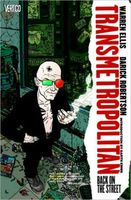
At the center stands Spider Jerusalem, a bald, tattooed, chain-smoking antihero inspired by Hunter S. Thompson's gonzo ethos. Foul-mouthed, drug-fueled, and abrasively brilliant, Spider is equal parts crusader and wrecking ball—driven by a pathological need to expose lies while battling his own addictions, rage, and vulnerabilities. His signature look (goggles, coat, and aggressive demeanor) and arsenal of custom tools, including a lethal "bowel disruptor," make him an unforgettable force of journalistic chaos. He is supported by his "filthy assistants," a pair of resourceful young women who evolve from reluctant aides to indispensable partners: Channon Yarrow, a tough, street-smart former stripper and bodyguard with a sharp wit and hidden depths, and Yelena Rossini, an intelligent, somewhat more refined daughter of privilege whose idealism clashes productively with Spider's cynicism. Their loyalty, banter, and personal growth add emotional grounding and humor to the mayhem.
Setting
The primary setting is The City, an immense, unnamed megacity that serves as both backdrop and antagonist—a teeming, multilayered urban organism in the 23rd century where skyscrapers pierce polluted skies, streets overflow with every conceivable subculture, and technology has rewritten daily existence. Hovercars weave through neon-drenched avenues, street vendors hawk designer drugs and illegal augmentations, and districts specialize in extremes: from the Angels 8 enclave of "Transients" surgically transforming into aliens, to zones of religious zealots, transient cults, and high-tech vice dens. The environment crackles with "future shock" details—flying news cameras, bowel disruptor weapons, genetic cocktails, and holographic billboards peddling everything from immortality to instant gratification—creating a sensory overload that mirrors the information-saturated chaos of our own era. Robertson's art renders this world with gritty detail and grotesque flair, turning architecture, crowds, and bodily modifications into characters themselves. Occasional forays outside The City, such as Spider's mountain cabin, provide brief, ironic contrasts of isolation amid nature.
Tone & Themes
Ellis crafts a tone that is ferociously satirical, darkly comedic, and unapologetically profane, laced with manic energy and visceral imagery. The storytelling pulses with outrage and black humor, never shying from graphic depictions of bodily functions, violence, or societal decay, yet it maintains an undercurrent of defiant idealism amid the cynicism. Themes cut deep into the heart of modernity: the corrosive power of unchecked authority and media manipulation, the dehumanizing effects of advanced technology and consumerism, the commodification of identity through transhumanism and body modification, the struggle for authenticity in a world of simulations and spin, and the redemptive potential of truth-telling as a form of resistance. It skewers religion, politics, celebrity culture, and social fragmentation while probing questions of what remains fundamentally human when everything—biology, society, morality—becomes customizable or disposable. At its core, the series champions the messy, painful pursuit of honesty as society's last defense against tyranny and apathy.
In the end, Transmetropolitan endures as a blistering, exhilarating assault on complacency, where one man's savage commitment to truth becomes a beacon in a neon-drenched nightmare. Warren Ellis and Darick Robertson deliver a series that is simultaneously hilarious and horrifying, prophetic and profoundly human, reminding us that in an age of spin, simulation, and spectacle, the unvarnished word retains explosive power. Spider Jerusalem storms through the pages like a force of nature, dragging readers into the filth and fluorescence of The City to confront uncomfortable mirrors of our own world. The saga leaves a lingering charge—of outrage tempered by hope, laughter sharpened by pain, and the stubborn conviction that journalism, however gonzo and grotesque, can still rattle the foundations of empire. It is not a gentle read but a necessary one, a wild transmission from a future that feels uncomfortably close, urging us to stay angry, stay curious, and never stop questioning the stories we are sold. In its chaotic glory, Transmetropolitan affirms that even in the gutter of tomorrow, someone must shine the light—and sometimes that someone wears goggles and swears like a sailor while fighting for something better.
FAQ
10 books
No new book is currently scheduled. The latest book, Transmetropolitan Vol. 10: One More Time, was published in August 2011.
Transmetropolitan Vol. 10: One More Time was published in August 2011.
The first book in the series is Transmetropolitan Vol. 1: Back on the Street, published in February 1998.
The series primarily falls into the Dystopian genre.
Yes, the series should be read in order. The books follow a continuous story, starting with Transmetropolitan Vol. 1: Back on the Street.
The core premise revolves around Spider Jerusalem, a legendary and reclusive gonzo journalist who emerges from self-imposed exile in a mountain retreat to plunge back into the heart of a sprawling, hyper-advanced metropolis known simply as The City. Hounded by deadlines and his own demons, Spider resumes his role as a relentless investigative reporter for the newspaper The Word, wielding his pen—and an arsenal of futuristic gadgets and drugs—as weapons against corruption, hypocrisy, and institutional rot. His stories expose the underbelly of a society where technology has accelerated every vice and virtue: genetic modifications, alien-inspired body alterations, rampant consumerism, political machinations, and the blurred lines between human and posthuman. What begins as episodic deep dives into bizarre subcultures and street-level absurdities escalates into a sustained crusade against powerful figures, particularly two successive U.S. presidents whose ambitions threaten the fragile remnants of truth and freedom. Through it all, Spider fights not for glory but for the raw, unfiltered truth, even as fame, violence, and personal toll threaten to consume him.
The series does not currently have a new book scheduled.