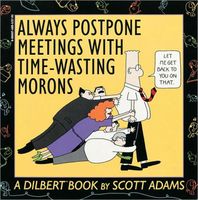
Dilbert Books in Order
#
Title
Date
About the Dilbert series
Series Premise
The Dilbert books take the core premise of the comic strip — a surreal, deadpan portrayal of corporate life as seen through the eyes of an intelligent but powerless engineer — and expand it into longer-form satire. The central idea is simple and consistent across both strip and books: - Corporate life is inherently absurd, inefficient, and often cruel. - Most management decisions are made by people who do not understand the work. - Employees are trapped in a system that rewards politics, jargon, and conformity over competence and results. - The average worker is far smarter than the system allows them to be, yet remains powerless to change it. Each book collects favorite strips on a theme (management fads, pointless meetings, performance reviews, cubicle life, downsizing, leadership nonsense) and surrounds them with Adams’s own essays, anecdotes from readers, fake “case studies,†and satirical “management secrets.†The books are part humor collection, part workplace manifesto, part self-help parody. The recurring message — delivered with deadpan sarcasm — is that the modern corporation is a theater of the absurd, and the only sane response is to laugh at it.
Main Characters
Dilbert: The everyman protagonist — an intelligent, cynical engineer with round glasses, a striped tie, and zero respect for authority. He is the voice of the reader: smart enough to see through the nonsense, powerless to change it. He is surrounded by idiots and survives by sarcasm and passive resistance.
- The Pointy-Haired Boss (PHB): Dilbert’s manager — incompetent, vain, cruel, and utterly convinced of his own brilliance. He is the embodiment of middle management: obsessed with buzzwords, metrics, and looking busy while accomplishing nothing.
- Wally: Dilbert’s coworker — the ultimate slacker genius. He has mastered the art of doing nothing while appearing to do everything. Lazy, brilliant, and shameless.
- Alice: The only woman in the engineering group — brilliant, foul-tempered, and terrifying. She solves problems with violence when logic fails.
- Dogbert: Dilbert’s pet dog — a ruthless, amoral sociopath who constantly schemes for world domination. He is Dilbert’s advisor, manipulator, and occasional conscience (in the most cynical way possible).
- Catbert: The evil director of human resources — a cat who delights in making employees miserable.
- The Boss’s Secretary (Carol) and various other recurring bit players (the Elbonians, PHB’s mother, etc.).
Setting
The setting is the generic, timeless North American corporate office of the late 20th and early 21st centuries. There is no specific company name, city, or year; the office is an archetype — cubicles, fluorescent lights, pointless meetings, motivational posters, endless email chains, re-orgs, downsizing announcements, and the ever-present specter of middle management. The company manufactures nothing identifiable; it simply exists to generate bureaucracy, PowerPoint decks, and performance reviews.
The office is deliberately placeless and dateless — no smartphones in the early books, no social media, no remote work — yet it feels eternal. It could be 1995 or 2015; the absurdities remain the same. Occasional strips venture into the outside world (home life, dating, shopping), but the heart of the series is the cubicle farm, the conference room, and the manager’s glass-walled office.
Tone & Themes
The tone is sardonic, cynical, deadpan, and relentlessly funny in a bleak way. Adams writes with the detached amusement of someone who has seen every management fad and corporate lunacy up close and found them all ridiculous. There is almost no sentimentality or hope for reform; the humor is rooted in the premise that nothing will ever get better, so you might as well mock it. The writing is conversational, self-deprecating, and frequently profane (especially in the books aimed at adults). The comedy is observational and cruelly accurate — it hurts because it’s true. Yet the tone is never bitter or despairing; it is liberating. By naming the absurdities of office life so precisely, Adams gives readers permission to laugh instead of scream. The books feel like a survival manual for the cubicle-dwelling soul: laugh, endure, and never take any of it seriously.
Scott Adams’s Dilbert books are a savage, hilarious, and strangely comforting dissection of corporate life — a collection of comic strips and essays that named the absurdities of the modern office so precisely that they became part of the language. Through Dilbert, Wally, Alice, the Pointy-Haired Boss, Dogbert, and Catbert, Adams created a timeless cast of archetypes that still feel painfully accurate decades later. The books are not hopeful; they do not promise reform or revolution. They simply say: yes, it really is this stupid, and no, it’s never going to get better — so laugh, survive, and keep your résumé updated. Yet in that laughter there is liberation. By mocking the system so relentlessly, Adams gave millions of cubicle dwellers a way to endure it without losing their minds. The Dilbert books remain a cultural artifact and a survival manual: proof that even in the most soul-crushing environment, humor is a form of resistance, and naming the absurdity is the first step toward surviving it.
FAQ
How many books are in the Dilbert series?
48 books
When will the next book in the series be released?
No new book is currently scheduled. The latest book, Not Remotely Working, was published in December 2022.
When was the most recent book released?
Not Remotely Working was published in December 2022.
What was the first book in the series?
The first book in the series is Dogbert's Clues for the Clueless, published in August 1993.
What genre is the Dilbert series?
The series primarily falls into the Graphic Novel genre.
What is the Dilbert series about?
The Dilbert books take the core premise of the comic strip — a surreal, deadpan portrayal of corporate life as seen through the eyes of an intelligent but powerless engineer — and expand it into longer-form satire. The central idea is simple and consistent across both strip and books: - Corporate life is inherently absurd, inefficient, and often cruel. - Most management decisions are made by people who do not understand the work. - Employees are trapped in a system that rewards politics, jargon, and conformity over competence and results. - The average worker is far smarter than the system allows them to be, yet remains powerless to change it. Each book collects favorite strips on a theme (management fads, pointless meetings, performance reviews, cubicle life, downsizing, leadership nonsense) and surrounds them with Adams’s own essays, anecdotes from readers, fake “case studies,†and satirical “management secrets.†The books are part humor collection, part workplace manifesto, part self-help parody. The recurring message — delivered with deadpan sarcasm — is that the modern corporation is a theater of the absurd, and the only sane response is to laugh at it.
Is the Dilbert series finished?
The series does not currently have a new book scheduled.
More Series Like Dilbert
If you enjoyed Dilbert, here are more graphic novel series to explore.