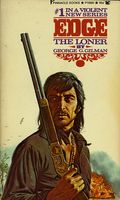
Edge Books in Order
#
Title
Date
About the Edge series
Series Premise
The series follows Josiah Hedges, a half-Mexican, half-Swedish former Union cavalry captain who returns from the Civil War to find his family farm destroyed and his younger, crippled brother Jamie brutally tortured and murdered by a gang of opportunistic ex-soldiers. Devastated and embittered, Hedges adopts the moniker "Edge" (a razor-sharp nickname reflecting his cold precision and deadly edge) and embarks on a lifelong path of vengeance, drifting across the post-war American West as a loner who takes on jobs for money while relentlessly pursuing personal justice, often leaving trails of bodies in his wake. Each installment typically places Edge in a new town or territory where he encounters greed-driven schemes, betrayals, bounty hunts, range wars, or random violence, forcing him into confrontations that test his skills with gun, knife, and improvised weapons, while his half-breed heritage and war scars mark him as an eternal outsider shunned or feared by society. The overarching narrative is episodic yet tied together by Edge's unchanging nature: a man driven by survival instincts, a code of pragmatic self-interest, and an unquenchable thirst for payback against those who wrong him or cross his path.
The series is best read in publication (or chronological) order to follow the subtle progression of Edge's character backstory, recurring motifs, and occasional callbacks to past events or enemies. While each book functions as a largely self-contained adventure with its own setup, conflict, and violent resolution—allowing readers to jump in at almost any point without missing critical plot threads—the cumulative effect of Edge's hardening cynicism, physical toll from endless fights, and rare moments of reflection builds across the volumes, enriching the experience for dedicated followers. Reading sequentially also preserves the intended shock of early reveals about his past and avoids minor spoilers from later references to previous exploits.
Main Characters
The undisputed central figure is Edge himself—Josiah Hedges—a tall, lean, ice-blue-eyed man in his late twenties to thirties whose mixed heritage (Mexican father, Swedish mother) gives him an exotic, menacing appearance accentuated by a thin scar across his cheek and a perpetual half-smile that masks lethal intent. Once a disciplined Union officer, the war and his brother's murder have stripped away any illusions, leaving a cold, calculating survivor who speaks little, trusts no one, and acts decisively when provoked. He wields a variety of weapons with expert precision—especially the razor he keeps in his neck pouch for close work—and rides a reliable horse named Stallion, embodying the classic lone drifter archetype taken to an extreme anti-heroic level. Supporting characters are typically transient: corrupt sheriffs, greedy ranchers, vicious outlaws, desperate women, opportunistic bounty hunters, Apache warriors, or fellow drifters who cross paths briefly before violence erupts. Few recur meaningfully, as Edge's loner status precludes lasting alliances; relationships are fleeting, often ending in betrayal or death. Occasional figures like old war acquaintances or temporary partners add fleeting depth, but the focus remains squarely on Edge's solitary, unforgiving journey.
Setting
The series is set in the post-Civil War American West of the late 1860s through the 1880s, spanning a wide swath of frontier territories from the Midwest prairies and Iowa farmlands (where Edge's tragedy begins) to the dusty towns of Texas, Arizona, California, New Mexico, and beyond. Locations include isolated ranches, boomtown saloons, Apache-haunted deserts, snow-swept mountains, river crossings, mining camps, and border regions where law is thin and opportunity (or danger) abounds. The era captures the raw aftermath of the war: displaced veterans, carpetbaggers, Native American conflicts, railroad expansion, gold rushes, and vigilante justice amid a landscape of unforgiving wilderness—arid badlands, vast plains, rugged canyons, and frontier settlements with wooden boardwalks, false-front buildings, and the constant threat of ambush or betrayal. Gilman evokes a gritty, unforgiving realism: the smell of gunpowder and blood, the sting of desert sun, the chill of mountain nights, and the ever-present dust of travel on horseback or stagecoach, all underscoring Edge's nomadic existence as he drifts from one violent episode to the next.
Tone & Themes
Gilman's tone is unapologetically dark, brutal, and cynical, embracing the excesses of 1970s pulp with graphic depictions of violence, torture, rape, and death that were shocking for their time and remain intense today. The series rejects romanticized heroism in favor of stark realism: Edge kills without remorse, often in inventive and sadistic ways (using razor blades, broken bottles, or environmental hazards), and the narrative voice delivers matter-of-fact descriptions laced with dry, black humor—frequently punctuated by Edge's sardonic one-liners or ironic observations about human nature. There's little moralizing or redemption arcs; justice is personal and bloody, women are often victims or temptresses in a harsh world, and authority figures (sheriffs, ranchers, outlaws) are corrupt or incompetent. Yet beneath the gore lies a consistent undercurrent of grim fatalism and subtle existentialism—Edge survives not through luck or virtue but through ruthless pragmatism and superior lethality—creating a tone that's exhilarating for fans of hard-edged action while repellent to those preferring gentler Westerns. The prose is lean, punchy, and fast-moving, prioritizing visceral impact over lyrical description.
The Edge series endures as a bold, uncompromising pillar of adult Western pulp fiction, redefining the genre with its unflinching violence, amoral protagonist, and cynical worldview while delivering relentless, adrenaline-fueled entertainment. George G. Gilman crafted an enduring anti-hero in Edge—a man shaped by loss and hardened by endless conflict—who roams a brutal frontier where survival demands ruthlessness and morality is a luxury few can afford. For readers drawn to gritty, no-nonsense action tales that prioritize raw power over redemption, the series offers a visceral, addictive ride through the darker side of the Old West, leaving a lasting impression of a lone figure whose edge cuts through illusion to reveal harsh truth. It's a landmark in pulp history, perfect for those who crave Westerns with teeth—unromanticized, unforgiving, and unforgettable.
FAQ
How many books are in the Edge series?
61 books
When will the next book in the series be released?
No new book is currently scheduled. The latest book, The Rifle, was published in January 1989.
When was the most recent book released?
The Rifle was published in January 1989.
What was the first book in the series?
The first book in the series is The Loner, published in July 1972.
What genre is the Edge series?
The series primarily falls into the Historical genre.
What is the Edge series about?
The series follows Josiah Hedges, a half-Mexican, half-Swedish former Union cavalry captain who returns from the Civil War to find his family farm destroyed and his younger, crippled brother Jamie brutally tortured and murdered by a gang of opportunistic ex-soldiers. Devastated and embittered, Hedges adopts the moniker "Edge" (a razor-sharp nickname reflecting his cold precision and deadly edge) and embarks on a lifelong path of vengeance, drifting across the post-war American West as a loner who takes on jobs for money while relentlessly pursuing personal justice, often leaving trails of bodies in his wake. Each installment typically places Edge in a new town or territory where he encounters greed-driven schemes, betrayals, bounty hunts, range wars, or random violence, forcing him into confrontations that test his skills with gun, knife, and improvised weapons, while his half-breed heritage and war scars mark him as an eternal outsider shunned or feared by society. The overarching narrative is episodic yet tied together by Edge's unchanging nature: a man driven by survival instincts, a code of pragmatic self-interest, and an unquenchable thirst for payback against those who wrong him or cross his path. The series is best read in publication (or chronological) order to follow the subtle progression of Edge's character backstory, recurring motifs, and occasional callbacks to past events or enemies. While each book functions as a largely self-contained adventure with its own setup, conflict, and violent resolution—allowing readers to jump in at almost any point without missing critical plot threads—the cumulative effect of Edge's hardening cynicism, physical toll from endless fights, and rare moments of reflection builds across the volumes, enriching the experience for dedicated followers. Reading sequentially also preserves the intended shock of early reveals about his past and avoids minor spoilers from later references to previous exploits.
Is the Edge series finished?
The series does not currently have a new book scheduled.
More Series Like Edge
If you enjoyed Edge, here are more historical series to explore.