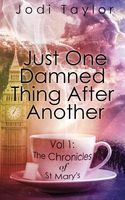
The Chronicles of St. Mary's Books in Order
#
Title
Date
Jun 2017
About The Chronicles of St. Mary's series
Series Premise
St. Mary's Institute of Historical Research is a seemingly ordinary academic facility affiliated with Thirsk University, but its true purpose is far more extraordinary: historians do not merely study the past—they visit it "in contemporary time" (they insist it's not "time travel," a phrase they avoid). Using small, pod-like time machines, teams of historians jump to major historical events to observe and record what really happened, strictly adhering to a "no interference" policy—though chaos inevitably ensues. The premise follows Dr. Madeleine "Max" Maxwell and her eccentric colleagues as they ricochet through history on missions that range from the fall of Troy to the eruption of Vesuvius, the Great Library of Alexandria, the Battle of Agincourt, World War I trenches, and beyond. Every jump carries risks: History is not passive and "punishes" interference (leading to disasters, injuries, or worse), pods malfunction, historians are accident-prone ("tea-soaked disaster magnets"), and external threats (rogue time travelers like Clive Ronan, rival organizations, or paradoxes) add danger. Max's first-person narration chronicles these "investigations," blending detailed historical research with escalating catastrophes, personal growth, and the unbreakable camaraderie of St. Mary's staff. Over the series, arcs explore the institute's survival, internal politics, Max's relationships, and larger threats to the timeline, while individual books deliver self-contained missions with escalating stakes and emotional payoff.
Main Characters
The series is ensemble-driven, narrated primarily by Dr. Madeleine "Max" Maxwell, a brilliant, red-haired, accident-prone historian in her late 20s/early 30s (aging through the series). Feisty, sarcastic, fiercely intelligent, and often self-deprecating, Max is the heart of St. Mary's—observant, loyal, and prone to disaster. She evolves from eager newcomer to seasoned leader, grappling with personal losses and relationships.
Leon Farrell is Max's primary love interest: a calm, capable technician and pilot with hidden depths; their slow-burn romance provides emotional grounding.
Dr. Edward Bairstow, Director of St. Mary's: enigmatic, dry-witted, unflappable leader—stern yet deeply caring, often one step ahead.
Markham, security chief: chaotic, loyal, perpetually injured; comic relief and protector.
Peterson (Tim), historian: gentle, bookish, Max's close friend.
Chief Clerk Mrs. Partridge (Kleio/Clio, Muse of History): mysterious, all-knowing assistant who intervenes subtly.
Other key recurring figures: Helen (medical), Dieter (security), Guthrie (security head), and various historians (e.g., Lingoss, Pennyroyal) who rotate in missions. Antagonists include Clive Ronan (rogue historian) and occasional threats from rival groups or paradoxes.
Setting
The primary setting is St. Mary's Institute of Historical Research, a nondescript building (disguised as a historic property) in rural England near Rushford, affiliated with Thirsk University. Inside, it's a chaotic blend of academic offices, labs, sick bay, and time-pod hangar—cluttered with artifacts, half-eaten sandwiches, and malfunctioning equipment.
The real magic happens in the past: historians "investigate major historical events in contemporary time," jumping to vivid, immersive locations across millennia—ancient Troy, medieval London, Renaissance Florence, the Cretaceous period, Victorian London, World War trenches, and more. These historical settings are richly detailed (based on meticulous research), capturing sensory immersion (smells of smoke and blood, sounds of battle, textures of ancient parchment) while showing how historians interact with (and disrupt) the past. The contrast between modern St. Mary's chaos and the weight of history heightens both humor and poignancy.
Tone & Themes
The tone is irreverent, fast-paced, and delightfully humorous—dark comedy meets heartfelt warmth in a style that is chaotic yet affectionate. Taylor's prose is witty, sarcastic, and self-deprecating (especially through Max's narration), filled with dry British humor, absurd situations, and laugh-out-loud moments amid danger. Expect frequent disasters (explosions, stampedes, historical figures spotting them), but the humor is never cruel—it's affectionate toward the characters' flaws and the sheer absurdity of time travel. Beneath the comedy lies genuine emotion: grief over losses, loyalty among colleagues, quiet moments of wonder at history, and poignant reflections on human resilience. The series balances light-hearted mayhem with darker edges—war's brutality, personal trauma, moral dilemmas—without becoming grim. It's uplifting overall: St. Mary's staff endure through friendship, tea, and stubbornness, affirming that even in chaos, humanity (and history) persists. Readers often call it "hilarious yet moving," addictive, and comforting—like a warm hug wrapped in explosions.
Jodi Taylor's The Chronicles of St. Mary's is a joyous, chaotic triumph of time-travel fiction: 15+ novels (plus stories) that combine meticulous historical detail, laugh-out-loud humor, and heartfelt emotion into an addictive saga of disaster-prone historians observing the past—and surviving it. Through Max Maxwell's wry narration and the St. Mary's crew's unbreakable camaraderie, the series celebrates curiosity, resilience, friendship, and the wonder of history while delivering clever puzzles and emotional depth. Whether facing dinosaurs, medieval battles, or modern crises, the books remind readers that even in the face of catastrophe, tea, loyalty, and a bit of stubbornness can carry you through. For anyone who loves witty, character-driven speculative fiction with heart and chaos, St. Mary's is an endlessly re-readable delight—one "damned thing" after another.
FAQ
How many books are in The Chronicles of St. Mary's series?
28 books total: 16 main + 11 extra stories + 1 companion book
When will the next book in the series be released?
No new book in the series is currently scheduled. The latest book, Murder at Martingale Manor, was published in December 2025.
When was the most recent book released?
Murder at Martingale Manor was published in December 2025.
What was the first book in the series?
The first book in the series is Just One Damned Thing After Another, published in September 2013.
What genre is The Chronicles of St. Mary's series?
The series primarily falls into the Science Fiction genre.
What is The Chronicles of St. Mary's series about?
St. Mary's Institute of Historical Research is a seemingly ordinary academic facility affiliated with Thirsk University, but its true purpose is far more extraordinary: historians do not merely study the past—they visit it "in contemporary time" (they insist it's not "time travel," a phrase they avoid). Using small, pod-like time machines, teams of historians jump to major historical events to observe and record what really happened, strictly adhering to a "no interference" policy—though chaos inevitably ensues. The premise follows Dr. Madeleine "Max" Maxwell and her eccentric colleagues as they ricochet through history on missions that range from the fall of Troy to the eruption of Vesuvius, the Great Library of Alexandria, the Battle of Agincourt, World War I trenches, and beyond. Every jump carries risks: History is not passive and "punishes" interference (leading to disasters, injuries, or worse), pods malfunction, historians are accident-prone ("tea-soaked disaster magnets"), and external threats (rogue time travelers like Clive Ronan, rival organizations, or paradoxes) add danger. Max's first-person narration chronicles these "investigations," blending detailed historical research with escalating catastrophes, personal growth, and the unbreakable camaraderie of St. Mary's staff. Over the series, arcs explore the institute's survival, internal politics, Max's relationships, and larger threats to the timeline, while individual books deliver self-contained missions with escalating stakes and emotional payoff.
Is The Chronicles of St. Mary's series finished?
The series does not currently have a new book scheduled.
More Series Like The Chronicles of St. Mary's
If you enjoyed The Chronicles of St. Mary's, here are more science fiction series to explore.