About This Book
THE ACTION takes place in a large commercial town of the East.
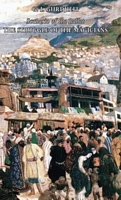
The market square where various streets and alleys meet: around it, shops and stalls with every variety of merchandise - silks, earthenware, spices; open-fronted workshops of tailors and shoemakers.
To the right, a row of fruit stalls; flat-roofed houses of two and three stories with many balconies, some hung with carpets and others strewn with washing.
To the left, on a roof a tea shop further on, children are playing; two monkeys are climbing on the cornices.
Behind the houses are seen winding streets leading to the mountain houses, mosques, minarets, gardens, palaces, Christian churches, Hindu temples, and pagodas.
In the distance, on the mountain is seen the tower of an old fortress.
Amongst the crowd moving about the alleys and the market square, types of almost every Asiatic people are to be met with, clad in their national costumes: a Persian with dyed beard; an Afghan all in white, with proud and bold expression; a Baluchistani in a white turban with a sharp peak to it and short white sleeveless coat with a broad belt, out of which stick several knives: a half-naked Hindu Tamil, the front of his head shaved and a white and red fork, the sign of Vishnu, painted on his forehead;. a native of Khiva wearing a huge black fur cap and a thickly wadded coat: a yellow-robed Buddhist monk, his head shaved and a prayer-wheel in his hand; an Armenian in a black ‘chooka' with a silver belt and a black Russian forage cap; a Tibetan in a costume resembling the Chinese, bordered with valuable furs; also Bokharis, Arabs, Caucasians and Turkomans.
The merchants cry their wares, inviting customers; beggars with whining voices beg for alms; a sherbet-vendor amuses the crowd with a witty song.
A street barber, shaving the head of a venerable old ‘hadji' recounts the news and the gossip of the town to a tailor who dines in the adjoining eating house. A funeral procession passes through one of the alleys; in front is a ‘mullah' and behind him the corpse is borne on a bier covered with a pall, followed by the women mourners. In another alley a fight is in progress and all the boys run there to watch. On the right, a fakir with outstretched arms, his eyes fixed on one point sits on an antelope skin. A rich and important merchant passes along ignoring the crowd, his servants follow him, carrying baskets laden with purchases. Then appear some exhausted beggars, half-naked and covered with dust, evidently just arrived from some famine area. At one shop Kashmir and other shawls and materials are brought out and shown to customers.
Opposite the tea shop, a snake-charmer seats himself and is at once surrounded by a curious crowd. Donkeys pass by, laden with baskets. Women walk along, some wearing the ‘chuddar' and others with unveiled faces.
A humpbacked old woman stops near the fakir and with a devout air, puts money into the coconut almsbowl standing near him. She touches the skin on which he is seated and goes away: pressing her hands to her forehead and eyes. A wedding procession moves by: in front are gaily dressed children, behind them buffoons, musicians and drumbeaters. The towncrier passes, shouting at the top of his voice. From an alley is heard the din of the copper-smith's hammers. Everywhere there is noise, sound, movement, laughter, scolding, prayers, bargaining - life bubbling over.
Two men separate themselves from the crowd. Both are richly dressed. One of them, Gafar, is a handsome.
well-built, wealthy Parsi about thirty or thirty-five years of age, clean shaven except for a small black moustache and close-cut hair. He wears a light yellow silk coat belted with a pale rose-coloured scarf, and blue trousers; over this a brocade robe, the skirt cuffs and facings of which are embroidered in silver; on his feet are high boots of yellow leather, the legs embroidered in gold and precious stones; his head is covered with a turban of a figured Indian material, its predominating colour is turquoise blue; on his fingers are rings with large emeralds and diamonds. The other man is his confidant Rossoula, dressed equally richly, but carelessly. He is short, stout, subtle and cunning, the chief assistant of his master in all his love affairs and intrigues. He is always in a sly and merry mood. On his head he wears a red skull-cap with a yellow turban wrapped round it; in his Hand is a short red rosary.
Gafar looks at some of the wares and stops occasionally to speak with some of his acquaintances, but evidently nothing interests him in all his movements one can see the pride of a man satiated with pleasures. To his equals he is patronizingly civil, but on everyone else he looks with contempt or aversion. He has experienced everything seen everything, and the things for which other people struggle and exert themselves no longer exist for him.
At this moment two women come out of a side street on the left, into the square. One of them, Zeinab, is young about twenty or twenty-two years of age, of an Indo-Persian type, more than average height and very beautiful. She is dressed in a white tunic with a green scarf round her waist; her smoothly-dressed hair parted in the middle is bound with a gold fillet: thrown over her head she wears a ‘chuddar' but her face is un-covered. The other is her confidant, Haila. She is a short, plump, middle-aged good-natured woman. She is dressed in a blue velvet coat under a violet ‘chuddar'.
Her mouth is covered with a handkerchief.
Zeinab holds a roll of parchment wrapped in a silk handkerchief. She passes along the square graciously giving alms to the beggars whom she meets. Gafar notices her and follows her with his eyes. Her face interests him because it seems, at the first glance, to remind him of someone or something. He enquires of Rossoula and other acquaintances who she is, but no one knows.
Just then, Zeinab goes up to a beggar woman near whom stands a half-clad boy about eight years old with an open sore on his naked arm. As she gives him alms Zeinab notices the sore and bending over him she speaks sympathetically to the beggar woman about him.
Finally she says something to her, pointing to one of the side streets and then to the boy. It is evident from her gestures that she is advising the woman to take the boy where he can be cured.
All this time, Gafar does not cease to observe Zeinab.
Zeinab wishes to bind up the boy's arm, but she has nothing to wrap round it, so she unfolds the silk handkerchief in which the rolls of parchment are wrapped and binds it round the sore. Then accompanied by Haila, she leaves the square by a side street.
Gafar quickly consults Rossoula. It is evident that he is giving him instructions to follow Zeinab and to find out what he can about her. When Zeinab has disappeared Rossoula follows by the same street. Gafar stands looking after him, then slowly goes up to the beggar woman and begins to talk to her. Recognizing the handkerchief on the boy's arm as the gift of Zeinab, he, without knowing why desires to buy it. He offers the woman some money, but she refuses to sell it. Gafar, thereupon throws down a handful of money and takes the handkerchief almost by force from the boy, then slowly walks towards the middle of the square. The astonished woman excitedly picks up the money and raising her hands to heaven, thanks Gafar. Then, taking the boy by the hand, she goes down the alley pointed out by Zeinab.
Rossoula returns and with deprecating gestures, tells Gafar that he has discovered that Zeinab is not a woman whom it is possible to approach casually. Then, still talking together, Gafar and Rossoula go out by one of the streets on the left.
Evening draws on. In one of the alleys there is much movement, and out from it comes a dervish accompanied by a crowd amongst whom are many women and children. This dervish has been much honoured in the country of late, and he enjoys great respect amongst all the different nationalities. He recites some sacred verses and to the rhythm of the verses he makes certain movements resembling gymnastics or a dance.